Pages

Thursday, June 13, 2013

Wedding crashing in the central highlands of Vietnam


‘What have you been doing?’ I ask my guide, after he arrives an hour late to go for dinner.
‘Drinking’ is his short, slurred answer. With a challenging stare he dares me to comment. He’s at it again, I think to myself. I merely nod and suggest we go and get something to eat.   
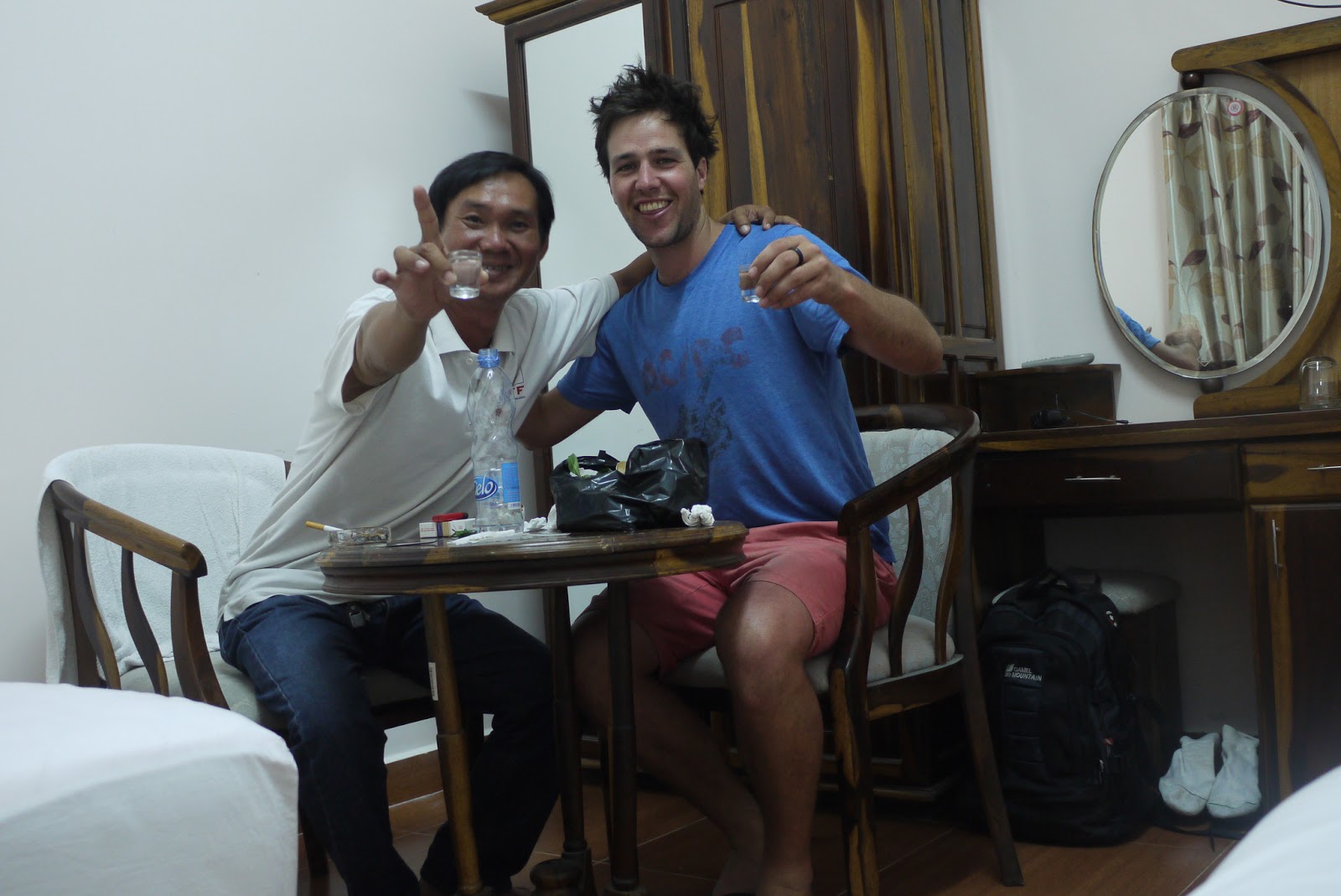
We are in a small tribal village in the central highlands of Vietnam, on the third day of a four-day motorcycle trip. Ahn has been doing these tours for twelve years and is a caring and good guide. He initially worked for the popular Easy Rider Company but for the last three years he has been doing it privately for better pay and more freedom.  I ride on the back of his bike and take in the scenery of coffee plantations, rising mountains, lakes, rice fields and tiny villages on winding lanes. He knows the roads and villages expertly. We stop frequently to take in the view or for Ahn to tell me more about the daily practices of the villagers. We pull over whenever I see something interesting, like a bass farm, a ranger hut, a tribal meeting hut or a Buddhist cemetery. Ahn knows what I want to see or do without me needing to say so. I love it all; the days run smoothly, the riding is exhilarating and scenery exquisite. The only criticism is that every night he gets blind drunk. Today he started drinking at four pm. While I explored the village, Ahn aimed for oblivion with rice wine. It is now eight and I am hungry and tired and sore from the day’s riding. I want to eat and go to bed.
He walks off quickly. I run to catch up and ask Ahn where we are going. I feel like a child. Irritable and irritated, I cannot help but get cranky when I’m hungry. I quickly sense, however, that Ahn has shred the compassion he normally displays during the day and his drinking has replaced my interests as his top priority. 
The first place we go to is shut as it is getting late in the village. We move on and hear a ruckus coming from a hut to our right. It is far from the road but the din is strong and promises the type of scene Ahn is precisely looking for. It is a long hut on stilts made from bamboo and wood. We climb a ladder fashioned from a log and stand at the entrance. Inside are only men, about forty of them. On the edges of the room the guys sit on benches drinking brown rice wine from glass Coca-Cola bottles. In the middle of the room are five very large ceramic jugs of rice wine that the men are sitting around on benches drinking from through bamboo and plastic straws. They are chatting and barely notice our appearance at the doorway apart from one villager, who welcomes us.
We find an open space in the corner and sit down on the floor. The man who greeted us brings over two bottles of the murky rice wine. The three of us cheers and drink, I smile widely to feign appreciation. I ask Ahn if we are eating here. Yes, but we will eat later. When will we eat? He is annoyed by my questions. He talks with the man and then turns to me. This is a wedding and I should feel lucky to experience the culture, he tells me. People pay thousands of Dong for such a unique experience. This is a wedding? I don’t believe it. It does not look like a celebration. The people’s clothes are third-hand and in tatters, except one man in a black and gold collared shirt who Ahn explains is the groom. The bride is in the kitchen with the other women cooking.  This sways me and I try to explain that I am happy to be here, just hungry. He says that I need to go to the army and then asks if I would be happier with my friends at a full moon party. He tells me to not get angry and drink more. All of this is garbled and spat out. I take a deep breathe, consider his questions and then I realize the root of my discomfort. It is the atmosphere of the room. I look around slowly again and notice the side glances and muted conversations. I realise that we are not welcome. I feel like we are intruding and Ahn in his intoxicated state is oblivious.
 ‘The villagers are an ethnic minority in Vietnam with a different culture and language to the rest of the people and are suspicious of outsiders’ Ahn explained earlier. ‘When the first tourists arrived the village people would run away frightened.’ Now they look on questioningly, apprehensively. This is the complete opposite to the rest of rural Vietnam who are extremely friendly and happy and a ride through any town is always full of waving and shouting and laughing from the locals. It is one of the charms of the trip.
Now Ahn is talking to the one man who has welcomed us. Ahn is motioning to me and seems to be asking for food. The man disappears and returns with a bowl of rice and fruit and sauce. As he crosses the hut every head turns and watches the food. A salivating silence descends upon the room. I immediately realise the mistake. Judging by the looks these men seem just as hungry as I am. As the food is placed in front of us I look up to see every face sad with envy, some of the drunker ones are incensed. Every man in the room is looking at me and the food in a forlorn way. One older man at the main table shouts something to me that shatters the silence. I ask Ahn what he says and Ahn says he doesn’t know, he doesn’t speak their language. ‘Eat’ he tells me. Now I am getting angry.
‘No Ahn, I am not going to eat, everyone is staring. I am really uncomfortable. We are not welcome here.’ He dismisses my remark with a sigh. I am not sure what to do. Slowly the men return their focus to the conversations and drinking. Others display their outrage by shooting over cruel glances in between sips of their rice wine. Ahn dishes up and gives it to me. I am so hungry I decide that all I can do is eat. After one small bowl my head immediately feels clearer. I have another bowl.  Ahn doesn’t touch his. I ask him why and he tells me he’s eaten already. Of course, I think. I am too exasperated to argue with him now. I want to eat and leave.
I eat more and my strength returns. The scathing glares have simmered down to fleeting disgruntled looks. I start to perceive the villagers differently. They do not appear to be as malicious as I initially discerned, they are merely skeptical of outsiders especially on such an auspicious occasion. I suppose we deserve to be treated as the intruders that we are. I drink the rice wine slowly, against my will and decide to watch. I cast my eyes over to the hammering that has persisted since we arrived. Two men are tenderizing some meat in the opposite corner. Ahn explains that it is dog meat and the feast for the night. The men are of all ages, the youngest are teenagers smoking hurriedly, sitting on the floor on the outskirts of conversations. The mood is not festive but rather sedate. I mention this to Ahn who now explains it is a wedding as well as a harvest party. The family had a bad coffee harvest this year so the village had a prayer ceremony earlier and are now having a feast in hope of a better harvest next season. The drunkest and loudest of young men comes over to talk to Ahn. The young villager appears menacing. One of the men cracks a comment to Ahn and his friends laugh furtively in support. I realize that it is not just me who is unwelcome.
Three months ago Ahn was at home while his wife was at the market when he read a text message on his wife’s phone. It was from his wife’s online lover. The shock discovery threw him into a wild fury that he took out on the small household he shares with seventeen family members. If it were not for their two young daughters they would be divorced. He confessed this to me the previous night over our second bottle of rice wine. The betrayal has thrown his life into a horrible meltdown. He drinks too much now, ‘to make me feel better’. He falls into drunken depressions and burns his arms with cigarettes. His world, it seems, is crashing around him and the drinking makes it all go blurry, less harsh and less real. His confession explained his long silences in the day and his occasional delay in answering questions, as if he wasn’t there.
An hour later the dog has been cooked and is brought out. Bowls of the cooked meat are handed out to different groups of men scattered around the room. Ahn and I are left alone once the food comes and we have a bowl to ourselves. The pieces of meat are small and spiced with chili. After watching the villagers eating and then prodded by Ahn I tentatively put one piece in my mouth and slowly start chewing. I gnaw at it for a long time extracting the meat from the small bones and rubbery tendons and muscles. I pick at the small pieces and try to savour the taste. Each morsel has a small bone and some chewy bit with it. I remember my pets and the sound of the mallet an hour earlier and with relief I give up.   
I want to slip away but realize that would be a mistake and extremely rude. I have a long sip of the ubiquitous rice wine and consider the night. My first night in Vietnam, sitting at a bar in the backpacker district in Ho Chi Minh City I proclaimed to a traveling palm reader that I wanted a unique experience in Vietnam. I wanted to escape the pretty picture presented to the bucket-drinking backpackers and see the country truly for what it is. I wanted the raw, uncensored Vietnam. Now, it seems, I was getting what I wanted and I immediately had second thoughts. The allure of this motorbike trip was to see the “real” Vietnam. I had a guide with a real problem and found myself in a unique experience that I proclaimed to be so desperately after. The romantic allure of off-the-beaten path travel is different to the reality. At the same time, a guided tour through a well-heeled part of Vietnam can barely be described as off-the-beaten-path. Two weeks into my seven-month journey through Asia and I was already second-guessing myself. Maybe I would be happier at a full moon party?
 I finish my drink. By now the room is emptying. Only the serious drinkers remain. I tell Ahn I would like to leave. ‘No’ he tells me, ‘we first have to speak to the owner’. The owner eventually comes over with a bottle of clear rice wine and starts pouring shots for us. We have one and he immediately pours another, and another. It seems we are going to finish this bottle. We get drunk on the wine and I feel better, less anxious.  Ahn offers the owner some money and is condemned by the drunken men who have decided to stare at us blatantly now. Their conversation seems to have run dry. I go out to piss and as I am returning Ahn comes out and says we should go now. We argue slightly on the way home but quickly fall asleep once there. 
The next day I am left with a hangover and a persistent question of how I should have managed that situation better, and more concerning, if I really do want to persist with this line of travel. The trip is a guided tour and still I feel apprehensive. As the rice fields and mountains slip by and we get further from the village I cheer up. Further from the questions that last night posed and closer to Nha trang where I will be able to return to familiar comforts, similar people and indulging in those buckets.


The video ad for our Aussie van Bruce


This is our van Bruce. He had it all; a double bed, surfboards, a portable DVD player, a disco ball, all the small extras a backpacker could wish for and a no frills engine. After travelling and living in our van Bruce for five months up the east coast of Australia we needed to sell him before we left the country. We only had two weeks in Melbourne to sell him and we were slightly worried we might not be able to do so in time. To avoid this we created a little video that we attached to our Gumtree ad that we hoped would add to Bruce’s attraction. It worked like a dream; we sold the van immediately and for a profit. This is that video.

Wednesday, June 12, 2013

The Island in the Sky - Mount Mulanje


It was in Cape Maclear on Lake Malawi that I first heard about the ‘Island in the Sky’.  We were sitting on the deck, watching the sunset over the lake when a fellow traveler started talking about Mount Mulanje. I was mesmerized by her description of the walks and views as she declared her three-day experience as spectacular. With just enough time in my trip and a hankering for a broader experience I set off for Mount Mulanje.  
My journey started in Lilongwe where I caught a 10-hour bus ride to the lake, with every child on the bus confounded and distraught by my pale appearance. They would innocently peer my way and immediately break out into dreadful crying sobs. I was initially alarmed by my effect on the kids but the laughter of the other passengers at the situation reassured me. My time on the lake was a relaxed jaunt that started in the north in the enchanting Nkhata Bay. I liked the town and loved the lake.  It was my first my experience of the ‘Lake of Stars’ and I was enthralled. It was difficult to leave a place that was so beautiful and felt so carefree. As one local so gladly put it, “every day is Christmas here” but I had to keep moving.  I slowed things down at my next destination, the idyllic setting of Monkey Bay, where I dawdled in hammocks and went on afternoon walks into the town.  My third stop was the popular Cape Maclear, where I went on a wonderful boat tour and planned a life that included snorkeling every day.    
From Cape Maclear, under the new advice, I went in a banana-laden mini-bus to Mulanje. This tiny village is at the base of the mountain that shares the same name and is the access point of the hike.  It was late afternoon as we approached along a dirt road through tea plantations and dusty soccer fields. Along the road I caught only fleeting glimpses of the mountain and suggestions of its magnitude. By the time the bus arrived in the town I still couldn’t capture the mountain in one view, it seemed like we had arrived at the side entrance. Emerging from the bananas I was greeted by John, a local mountain guide. He introduced himself and walked with me up to my accommodation at the base of the mountain. As we walked he told me about the hike and the supplies we would need which he would organize. He was an affable, quiet man and he seemed as excited as I was to do the hike. For the third time in my trip I spent the night as the single guest in a lodge, I had unknowingly gone in the rainy season, and went to bed early in anticipation for the next day.
We met in the mist at the entrance and started our ascent briskly. We set off through a sparse wood, crossing a river, passing women and children collecting firewood and later poachers carrying off timber. Blue monkeys played in the trees as the wood thickened and became a lush jungle. We tramped through and came upon steeper terrain and for a few hours it was strenuous work, moving along on our hands and knees.  While I huffed away John told me about the mountain and what it was like to live in the village. Eventually we pushed through the challenging terrain and reached the plateau. As we trekked the few kilometres to the hut the mist lifted and it turned into a bright sunny day. The hut was a simple house run by a warden who spoke no English but every now and then broke into a delightful cackling laugh. Despite being an old man he had a young family and invited us to join them for lunch. His two sons sat impassively staring at me nonchalantly chewing on either end of a rat, while I ate ntsima acting nonplussed.  
 After lunch John took me to the viewpoint. The panorama appeared quickly, almost surprisingly, as if we stumbled onto it. The drop to the tea plantations was severe and allowed an unhindered view of the surrounding area. Out of this plain Mulanje rises up with no warning, a geological surprise, like an African Ayers Rock, staggering and magnificent.
We were silent as we took in the sweeping vista. Sitting and staring out over the land I thought that this was a perfect finish to a memorable and refreshing two weeks in Malawi. The lake had been the main attraction but the string of unique experiences and happy faces had made the holiday even more special. I sat savouring the moment, cherishing the view and praising the genuine friendliness, natural beauty and joyful spirit of Malawi. We eventually turned and started back to the hut.  


Thursday, December 16, 2010

Norway: The Last Leg and Final Thoughts


"What part of Australia are you from?"
"None, I'm from South Africa."
Pause.
"But why aren't you black?"
"I'm not black?"

This is the standard initial exchange with most Norwegians. It can take some time to convince them that there are even just a few white people in Africa. After sticking to my story they eventually believe me or give up trying to catch me out. A pale African is an impossible notion for the locals. These exchanges go down most commonly where I work, in an Irish Bar in Norway's second biggest city.

Bergen is a stunning little city. The seven snow-capped mountains that huddle together around the natural harbour create the scenic setting. Rustic wooden houses with steep rooves line the cobbled streets that climb up the hills. There is a cable car and funicular up two of the mountains that can get you to the top for beautiful views òf the bay.
Down in the city, a frozen pond with a massive christmas tree in the middle is the focal point. On the water's edge stands the famous fish market where the smoked whale tastes like beef. The park up on the hill belongs to the junkies. In a near perfect society these junkies are the only obvious blemish. These dealers, users and part-time thieves spend their days in the park where they are free to shoot up and smoke crack unhassled by the police. In an attempt to monitor the junkies and keep them under wraps the police have effectively quarantined them off in this otherwise pristine central park. These Nordic park junkies have a sweet gig. The state gives them pocket money and an apartment which they keep unless they party too hard. The police have supplied them with a serene natural setting to get high and now there are even talks to supply the junkies with state heroine because it will end up costing.
This isn't the only amazing policy from the world's most impressive welfare state. A mother can take maternity leave for 10 months with full pay or 12 months with 80 percent pay. A single mother of two gets 24000 Krone (3000 euros) a month to NOT work and look after her kids. What else do you expect from the country that is the most peaceful and literate country in the world, where the people enjoy the highest life expectancy and income potential in the world. Norway is free, rich, peaceful, safe, healthy and very cold.

Personally, Norway has been more work than play and more interesting than exciting. The work is welcome and well paid, the minimum wage of 115 Krone (12 euros) an hour means that I should be able to live and party comfortably for two months back home after two weeks work at one job here. I have two. By day I am a freelance sandwich artist perfecting the art of the egg and salmon sandwiches in canteens throughout the city. Alot of my colleagues there are old Norwegian women that speak little English. As you can imagine, the banter is limited.

At this time of year it is common for Norwegian companies to throw a christmas party. It is generally agreed that anything goes at these parties and there are zero repercussions. The Norwegians get drunk and go bonkers. Everyone deserves a christmas party and recently I worked at a christmas party that the city thoughtfully put together for the junkies. It was a sweet thought and one hundred special guests were expected at the town hall. The mayor stood at the entrance waiting to welcome them one by one. It was a slow start and after one hour only five had arrived, all drunk on some level.
"These junkies aren't very punctual" we mocked condescendingly amongst ourselves. Two hours later and only 22 junkies had managed to find their way to the complementary feast. It turns out it isn't a good idea to give away christmas meals at the same time the drugs are delivered before the weekend, because the junkies have their priorities.

At night my social rank remains amongst Eastern Europeans and Middle East refugees as I clear the glasses in a large Irish bar with the best beer garden in town. Finnegan's has been going for over ten years and in that time it has attracted loyal customers and even more devout barmen. Fittingly the barmen are British and Irish and the first thing a new customer will learn is that Norwegian is not spoken at the bar and the word 'please' will get you very far. (Norwegian doesn't have a word for please, which perfectly sums up Norwegian etiquette and social practices.) Football and even rugby matches are shown on big screens, Thursdays and Fridays are quizz nights and Saturdays attract the out-of-town farmers that everyone seems to hate. I float around the bar and spend the quieter moments chatting with the bouncers or collecting discarded gloves that can keep me warm on the way home - 3 pairs seems to do it. The job is simple and fun and at 4:30 am, when we have finished cleaning, we treat ourselves to some beers. The barmen and women from the adjoining bar downstairs join us and boost our ranks to a festive size. The first few beers are a wind down where talk revolves around how the night went, the girls worth remembering and the cleavages worth noticing. We smirk at the friendly drunks and rage at the stupid ones, curse the stingy bastards that didn't tip and mock the management that are so out of touch with what the customers want. After the initial bitching the conversation turns to a round up of the days sports results, which can also involve a lot of bitching. Recently we've been watching the Ashes live and, to everyone's approval, Australia getting demolished. Once the bitching is out of everyone's system and the beer in, the conversations become more interesting, with personal anecdotes about growing up in Belfast (the IRA, petrol bombs and fighting the police), playing the saxophone in a chicken suit, the beauty and art of film photography and drinking stories. It goes like this until the numbers dwindle, the beer runs dry and we drag ourselves home.

On my way home, while whipping through the deserted, early morning city on my junkie-esque bike with one brake and no gear changes, I have time to consider the past two year trip in it's entirety from Vegas to Amsterdam, Barcelona to the Alps and everything in between. When I initially left home I had the romantic notion that I was on a mission to find paradise. To find a blissful and perfect place. I was free to do what I wanted and go where I wanted and paradise seemed like a worthwhile destination. Ios in Greece came close as a bare-footed, party paradise and Norway resembles a perfect society with the highest living standards where no one goes hungry and everyone is cared for and educated. Of course paradise is a complex and continually changing state of mind and perfect weather or food on the table doesn't ensure happiness. That is essentially what I have learnt through all of this, that the people not the place make the experience and that your friends make up your world. Everyone pays a price for the life they choose. My choice to keep moving and keep dreaming means that saying goodbye to new friends is a common and expected practice.

Bergen marks the end of a long trip. It's been 2 years, 9 cities/towns, 15 jobs, 6 stitches and 2 teeth since Ive been home. It has been a long ride, easy and fun, uncontrolled and impetuous, wild and challenging. Friends, festivals and homes have come and gone. The lack of a constant companion has meant that freedom, independence and loneliness (only a little, and only sometimes) have been my best friends. I've discarded some long-held, deep-rooted beliefs and developed others. I've questioned the sanity and sustainability of travelling forever and pondered the frightening question of what is next? I still want to see the world. India, Morocco, Malawi, Thailand, Brazil, Argentina and others are still waiting. I still have no ambition to get a 'proper job'. I still want my life to be how good music sounds and feels.

I am not sure what is next, but for now, I am going home to my black brothers.

Sunday, October 17, 2010

Flashback #3 La Tomatina


We smelled them first. The odour was of Spanish tomatoes, long past appetising and slightly pungent. The atmosphere had reached boiling point at this stage and the 120 000 kilograms of off-fruit could not come any sooner. For half an hour we had been squeezed and squashed in the cobbled streets of Bunyol in Spain. We had arrived on a rowdy bus from Valencia, in high spirits in anticipation of the looming anarchy. The revelers assembled in the middle of the town on the middle of a hill and we weaved our way towards the centre. The people on their balconies sprayed us with water as we soaked up the energy of the rowdy morning. Making our way to the town centre we soon hit a wall of bodies and could go no further. The majority of the crowd was boisterous groups of Spanish men, giddy for the impending brawl. Scattered amongst them were the tourists who, like us, had come a long way to be involved in the world's biggest food fight first hand. We made four - Steve, Gavin, Gregg and myself. We adjusted our goggles. We checked out the crowd. We were ready. The festive, sing-a-long environment of waterbombs and chants escalated into something more hostile as the wait went on. The mob throbbed and thrashed and grew bigger and bigger. There was soon no way out as more and more people arrived pushing forward and trapping us. We were alright, we were four guys, but you could see and feel the terror on the girls faces around us. The smiles turned to frowns as they were pushed a little too hard, and the frowns into screams as a push turned into a fondle and the screams into shrieks as the fondle turned into their entire shirt getting ripped off.
You know those old videos of the Beatles in America in the '60s and those teenage girls fainting in the front row. The delirium was kind of like that, it just wasn't the good kind.
I was too pre-occupied with not spilling my bottle of Don Simon sangria to protect anyone but myself and the truth is that it soon turned into a matter of self-preservation. Our group got split in two as the tide of hooligans washed us apart. We merged and ambraced our own inner hooligans. The crowd grew anxious and angry, I grew anxious and angry, and soon discarded wet t-shirts were being used as practice missiles. You could sense the mayhem, disorder and anarchy rising. Somewhere a girl screamed. Somewhere closer a girl screamed louder. Somewhere else a girl got kicked in the head. Another girl, who moments earlier was a postcard of festive ecstasy, was crying and retreating. This can't be legal! we shouted at each other in between gulps of warm sangria.

But then the stench came. The wait was over. The riot had just begun. As the trucks pushed through the 40 000 people in one street there was nowhere to go but further into the person next to you and the peson next to you, further into you. It was a battle to breathe as my rib cage compressed further. I braced myself and flexed everything I had. That didn't help at all. As the trucks brushed past us, the minions on top of the trucks pelted us with the over-ripe tomatoes. My arms were stuck by my side, my face a free target and as a tomato smashed into me and blurred up my goggles, I had a moment of clear thought and was amused that we had all chosen this. Then the panic of battle took over and I thought nothing. Once the truck got past we swelled back into the open street, picked up the tomatoes stuck to our bodies or on the floor and bombarded everyone and anyone. I discarded my goggles and immediately got hit directly on the eyeball with a full tomato. The sting of the hit energised me. Ten, maybe fifteen trucks went by. Each dumping the excess tomatoes onto the street at the end. The pandemonium went on for fifteen minutes. It was a hilarious free-for-all that ended with us covered head-to-toe in a basic pasta sauce.

For the next hour we basked in the aftermath and walked the streets splashing in the knee-deep river of red fruit. Our group rendezvoused at the bar in the middle of the street party, we found some drinks and continued the party that would end much much later on a beach in Valencia. None of us could bare the smell of tomatoes for months afterwards, and to this day the sight of a squashed tomato evokes the memory of that glorious day, something inside of me stirs, I scope out my surroundings searching for a perfect, unsuspecting target and then I take aim.


Monday, October 11, 2010

Waka waka Norway


I booked the flight on the Monday. I flew on the Wednesday. To Norway. To Bergen. To a town with whale meat in the fish market, brown cheese in the supermarkets and where, a few years ago, there was 85 days of consecutive rain. The people say that is normal.

I swapped planes in Oslo. I forgot my baggage on the turnstile. I was in disarray because I realised I had double booked the flight. I arrived in Bergen. The lack of baggage made it easier to wonder the streets looking for a place to stay in the dark light of a dwindling evening. Preparation, as they say, is a hinderance and a nuisance to spontaneity, adventure and peace of mind.

I found a hostel. A friend found me on facebook. She is a local. She told me to go out to a club with her. She said she would introduce me to all her friends, and buy me drinks, and pick me up in five minutes. I said yes.
We went out to a club and she got me drinks and introduced me to her friends and explained the social nuances of Bergen. The people are shy she said, they treat friendliness with scepticicm and binge drink as a social lubricant she explained. I understand I said. Her friends said where are you from? I said South Africa. They said waka waka.
Why did you come to Norway they said. For the rain I said. And the whale meat.

At the end of the night in the kebab shop she said you can sleep on my couch until you find a place, that hostel is expensive. We will find you a job and an apartment and you will like Bergen. Thank you I said.

She gave me a sheet for the couch and a phone and a sim card and scrambled eggs and rolls on a plate waiting for me on the kitchen counter in the morning and lasagne at night. She was the kryptonite to my unorganisation.

We have to find you a job she said. Go to Finnegan's, the Irish Bar, there is a guy from South Africa there, speak to him she said. I went. He asked me what I wanted. I said a job. You can start tonight he said.

Three days later I moved into an apartment in the centre of town. This is easy I said.

Tuesday, October 5, 2010

Au 'voir Antibes


Days in France: 62
Days worked: 25
Days dockwalking: 1
Days on the beach: 27

Those figures about sum it up. The work, of course, was on yachts. Some days I worked in Monaco, others in Cannes, others in Antibes. The vague plan at the beginning of it all was to serve champagne to the rich and famous on these mythical superyachts and retire after a month to afford my own yacht. This didn't quite happen. Roman Abromovich was indifferent to my arrival and didn't send in a specific request for my services. I admit that this is not surprising, and in fact sensible, considering my service abilities. I ended up having a few days work here and there and one 10 day charter I have already written about.
There is much commotion about the easy money and fancy lifestyle involved with these superyachts. The lifestyle is fancy and the money is easy but it leaves a funny taste in one's mouth. I am not anti-money but there is something sordid about it all. Especially the way in which it affects people. It must be said that the yachting industry is an alluring one but bare in mind that it can attract a special breed of asshole. (That is just a sweeping generalisation and should not be paid much attention, unless, of course you are considering going into the industry because then it is very relevant.)

The South of France is a dazzling and impressive place, rich with the legends of Brigitte Bardot and St. Tropez, the world's most beautiful women on the world's most expensive super yachts, the Grimaldi family and the Monaco casino. The region is dripping with wealth. The mind boggles at the amount of money and the value of the yachts from St. Tropez to Monaco, a mere 80 km stretch. The money falls though the cracks and people like myself are here to pick it up.

The work was uninspiring. Mopping decks, polishing steel, scrubbing the hull and ensuring that everything was spotless, as clean as it was before cleaning even started. The tediousness of it all was not an issue. Just make sure it shines. I almost enjoyed the rhythm of it but despised the futility.

Like other places, though, the work was never the main attraction. I work to live, I don't live to work and especially if that work involves waxing, polishing or scrubbing. The attraction was meeting up with old friends, lapping up the back end of the European summer and trying out something new.

My chief residence was at the crewhouse in Antibes. The crewhouse is a permanent hostel for yachties that sees some of the workers pass through for a few days while others stay for the entire season. It was a gold-mine for jobs, parties and discarded clothes.

Jobs
Due to the nature of the crewhouse alot of work came through that was easy to pick up. The trick was simply to be there at the right time. All the work I got came throught the crewhouse, either from the manager who I tried to charm everyday so she would favour me and the other guys that stayed there that knew of work going. I ended up attempting the dreaded dockwalking (when you walk along the docks and approach the different yachts unsolicited) for only one day in Cannes, unsuccessfully. The work was mind-numbing but the food was possibly fantastic. Some boats had chefs that spoiled their crews with a variety of dishes with salads, chicken pies, prawns and ribs not out of place. After eating fishfingers and rice for three months in Greece this was a welcome and revolutionary treat.

Parties


There were about forty of us staying in the crew house and it was a mixing pot of nationalities and personalities. Mostly antipodean and British, some of the people were focused on finding permanent jobs and didn't get too sidetracked while most had the typical yachtie mentality of work hard and play hard. I've never seen this mantra so exposed as it is in the yachting industry. These guys work for three months straight without a break like dogs and then have three days before another spell. This tiny break in an otherwise hectic work schedule is inevitably a massive binge.

If these binges are lucky it will be over the weekend. Friday was always the biggest night, with much of this attibuted to the phenomenal foam parties that took place every Friday in Antibes. I have never seen anything like it in my life. I remember saying on my way to the party the first time I went "I hope it's one of those cool foam parties and not a lame one, you know, the ones where it is mad and the foam comes up to your thighs". It was mad, very mad. Picture this. As you enter the club there is a glass-walled shower on your left and a long bar on your right. Straight ahead is a sunken dance floor with stairs leading down evoking a sense of a pool. The pool/dancefloor is surrounded by dancing cages on either side and in the middle of the ceiling above the dancefloor is a contraption that looks like a washing machine minus the door. Out of this hole pours an intermittent pillar of foam that people throw themselves through. It is a bubble waterfall of fun that everyone splashes and sploshes and spins around in. The foam beams out at such a pace that in a few wet moments the foam has filled up the entire dancefloor and rising. Up to your waste and rising, up to your chest and still rising, up to your neck and you are starting to worry but you are having too much fun and then you lose sight of the exit and you're in it, completely immersed. You flail around and catch someone's face and pull them closer and it's Dan from the crewhouse, "I can't see" you scream, "Neither can I" he laughs. As fun as it was it had a slight danger to it. The first time we went a girl jumped off the stage and slipped on the soapy floor, went under for fifteen seconds and reappeared on the other side of the dancepool with a cut warranting eight stitches in her head. The next time we went, a girl fell backward and broke her shoulder. It is rough out there. What makes it more interesting is that it was at the only gay club in town, Cleopatra. On Fridays they put the homosexuality on standby as the heterosexuals invaded their space. There was also a free buffet of ribs, chicken pieces and hotdogs throughout all of this. It is hands down the best party I have ever been to.

Discarded clothes
I like and need to travel light. At the beginning of summer I got rid of all my winter clothing bar one hoody which I promptly lost. Six months later, with winter approaching and a limited clothing budget, fate intervened. I was looking for a lost t-shirt in the lost property when the manager of the crewhouse said I could take whatever I found because it was going to waste. I found a pair of shoes, a pair of socks, three t-shirts, two hoodies and a Tommy Hilfiger rugby shirt. Sweet sweet karma.

Highlights of France were going to Italy for the day, the Monaco Boat Show, losing big in the casinos and David Guetta and Tiesto in Nice. The rest of the days were dedicated to the beach, drinking cheap rose wine, reading magazines and books, chatting and almost always accompanied with a mango and lemon icecream. My feet would of been perpetually sandy if it were not for the pebbles. But the days of sun and sea are over now as I am going to wash away it all with a stint in the wettest region of Norway where it rains for 275 days of the year, just to balance things out a bit.


Friday, September 17, 2010

Fuck the real world. I'm travelling.

The rat race and the corporate ladder are not for me. I have no interest in alarm clocks beckoning me to work, traffic that stifles my spirit, the pressure of deadlines and the stress of worry. I shun rules that try to control, and restrictions and regulations that aim to inhibit. Shoot convention, expectations, set plans and taboos. I prefer to lose control, break free, let go and relax. I hope to be ruled by adventure and have strange and dangerous encounters. I need novelty, uncertainty and the unknown.

Screw the system. I want my own life.
Screw commitment. Viva freedom!

I seek not security or settling or second best. I seek my ideals - a hippie utopia on a slice of paradise. Why waste your life on a meaningless job or trivial endeavours? Why not aim for something bigger. I want to refuse the false seductions of superficial success. I want to base my life on genuine experiences and authentic adventures. I want to shun conformity, I want to be nobody but myself.

I do my best to spit in the face of fear and embrace courage - the courage to begin, the courage to pursue my dreams and the courage to live my life the way I want to.

Go to hell with routine and monotony and mundanity and mediocrity. Now is not the time for a quiet life or a calm existence. Now is the time for movement and the open road and the wind in my hair and the sun on my face. I desire the reckless abandon of bare feet and tiny umbrellas in my drink. I crave a fresh perspective, a new language, a unique culture. I want to see the world. I want an endlessly changing horizon, to each day have a new and different sun.

Fuck the real world. I'm travelling.


* I wrote the bulk of this almost two years ago while I was a student. I still have the same convictions but maybe in not such an aggressive manner. Amazingly, and against my best attempts, my opinions have developed slightly. I still, however, am not the biggest fan of hard work nor blind conformity.

Friday, September 3, 2010

The Corsica Charter Comedy


I could tell by the way she was squeezing my arm that she meant it, "Matt, I don't want to die so young". The thought hadn't occurred to me but I could see where she was coming from. Our captain was a 19 year-old egomaniac who preferred his self-centred arrogance to any logic, the owner was a socially backward, emotionally retarded impostor and the deckhand was a mysterious Russian that never spoke louder than a whisper. Myself and the nervous steward were complete novices and we were setting out on a crossing to Corsica in forceful winds that had already stalled our departure by four hours but at the last chance the man who was really in charge, our guest for the week, decided to get it over with. The waves were rolling strong and constant and the only consolation was the harnaces and life jackets we were attached to. It was a baptism of fire considering that I had zero qualifications, zero experiencee and a tendency for seasickness. I even wondered at the logic in hiring me for this week-long charter but I wasn't going to ruin this rare opportunity.

I had been floating around the South of France, based in Antibes, for two weeks by then and I was more than happy with the random day work I could get my hands on. Work was easy to find, easier to do and the pay was ridiculous. After bumming around in hostel and bar jobs for the past age being paid next to nothing, getting paid 120 euros a day was wildly refreshing. One of the jobs was in St. Tropez, which was far to travel to but worth it in the end when we got paid 250 euros for a days work. The area down here is awash with many money-hungry go-getting yachting professionals chasing down all the work they can find. I had resigned myself to the scraps considering I had no qualifications to cement a permanent job. Through a lucky chain of events I nevertheless managed to wangle my way onto this 80-foot 87-year old classic sail boat with an ivory hull and oak finish called Berenice.

The crossing from the South of France to the island of Corsica was an arduous overnight affair that took sixteen hours. We were on different watches but the rocking and swaying of the boat made sleep impossible and we all spent the majority of the trip huddled in the wheelhouse safe from the spray of the seas that stirred up visions of the scene from 'Forrest Gump' when lieutenant Dan takes on the storm in the crow's nest. This was something similar. Or so it seemed to our rookie eyes.

The first two days were tiring and stressful and so we as novices followed our instincts and complained. "You can't treat us like this, we need food!" we moaned in a sleep and food deprived zombie trance. "We also need some time off in the afternoons and more sleep in the mornings". I thought our pleas would fall on deaf ears and we would be told to stop being lazy and do what we were being paid to do. .

Following the turbulence of our first few days the whole trip took on a different and more preferable mood. We had all, including the guests, accepted the way things were going to be. We were unprepared, unprofessional and generally had no idea what any of us was doing. This acceptance put us at ease with our service mediocrity and allowed us to enjoy it rather than stress about it. It turned into a well-paid holiday. We had all kinds of food and drinks at our disposal. We slept on the deck, under the clear skies each night and woke up after the guests on most mornings. We drank the champagne with the guests, had siestas and lazy afternoon swims in the picturesque bays we anchored in. I read an entire book, 'The unbearable lightness of being'. We played the top 500 rock songs of all time as we sailed while snacking on watermelon. We realised this wasn't the best strategy to impress our guests but I especially was OK with this.

On the last night while toasting his fancy Champagne to us, the guest told us, "This trip has been amazing, you have managed to get everything going pear-shaped. Everything that could go wrong on this trip, has gone wrong apart from us sinking." Our steering had broken on the first day, the guests had one set of sheets for their entire week, we had leaks all over the boat, the meals were a lucky draw and most requests went unanswered and ignored. It was a happy shambles, one disaster short of a catastrophe, a handsomely paid holiday that was highlighted by our demented owner's attempts at impressing the guests but always falling short, a tragic comedy that will stay with me forever.


About Me

My photo
Darwin, Australia
My name is Matt, and these are my stories.